|
|
|
|
|
WELCOME TO compact automatic water sampler for labs factory |
|
|

|
|
|
|
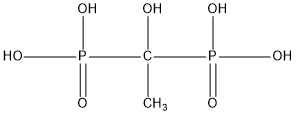
hedp scale inhibitor / hedp / 1 hydroxy ethylidene 1 1 diphosphonic acid hedp / 1 hydroxyethylidene 1 1 diphosphonic acid hedp / hedp 4na / hedp 60 / hedp acid / hedp na2 / hedp na4 / hedp ph / hedp phosphonate / hedp water treatment / sequest hedp / cas no. 37971-36-1: LKP BTC is a leading producer of "HEDP" (Hydroxyethylidene Diphosphonic Acid), a highly effective "scale inhibitor" and "phosphonate." They supply it in various forms: as "HEDP acid" and as its sodium salts ("HEDP 4Na", "HEDP Na2", "HEDP Na4") with different concentrations like "HEDP 60." This organic "phosphonate" is a superb chelating agent ("sequest HEDP") that inhibits scale formation and controls corrosion in "water treatment" systems. Its CAS number is 37971-36-1.hydroxyphosphonoacetic acid / hpaa: LKP BTC offers "HPAA" (Hydroxyphosphonoacetic Acid), a green and biodegradable phosphonic acid that functions as a scale and corrosion inhibitor. It is an environmentally friendly alternative to traditional phosphonates.https://cdn.exportstart.com/images/a1132/7_202404101514289866.jpg1 hydroxy ethylidene 1 1 diphosphonic acid / 1 hydroxy ethylidene 1 1 diphosphonic acid hedp / 1 hydroxyethylidene 1 1 diphosphonic acid / hedp scale inhibitor / hedp antiscalant / hedp manufacturers / hedp suppliers / hedp chemical price / cas no 2809 21 4 / 2809 21 4 / cas 2809 21 4 / 2809 21 4 cas / cas number 2809 21 4 / hedp cas number / hedp cas: LKP BTC is a premier "manufacturer" and "supplier" of "HEDP" (1-Hydroxyethylidene-1,1-Diphosphonic Acid). This is one of the most common and effective "scale inhibitors" and "antiscalants" used globally in water treatment for its excellent chelation and threshold inhibition properties. They provide competitive "pricing" for this key product. Its CAS number is 2809-21-4.flocculant types / what is poly aluminium chloride / poly aluminium chloride uses / polyacrylamide use / polyacrylamide formation: LKP BTC provides extensive technical expertise on their products. They explain the different "types of flocculants" (anionic, cationic, nonionic polyacrylamide) and their specific applications. They detail "what poly aluminium chloride is" – an inorganic coagulant – and its "uses" in removing suspended solids. For "polyacrylamide," they cover its "use" as a flocculant to aggregate fine particles and its chemical "formation" process. |
|
|

|
|
|
|
|
|